The left front burner clicked on and on without catching. He lifted the cap, showed me it had been seated a half turn off after a cleaning, dried the spark electrode and reset it. First click every time now.
Marisol H.2026-07-28
Sealed burners that click without lighting, burn yellow, or run uneven across the top. The dominant fault class on Clay County ranges and rangetops.
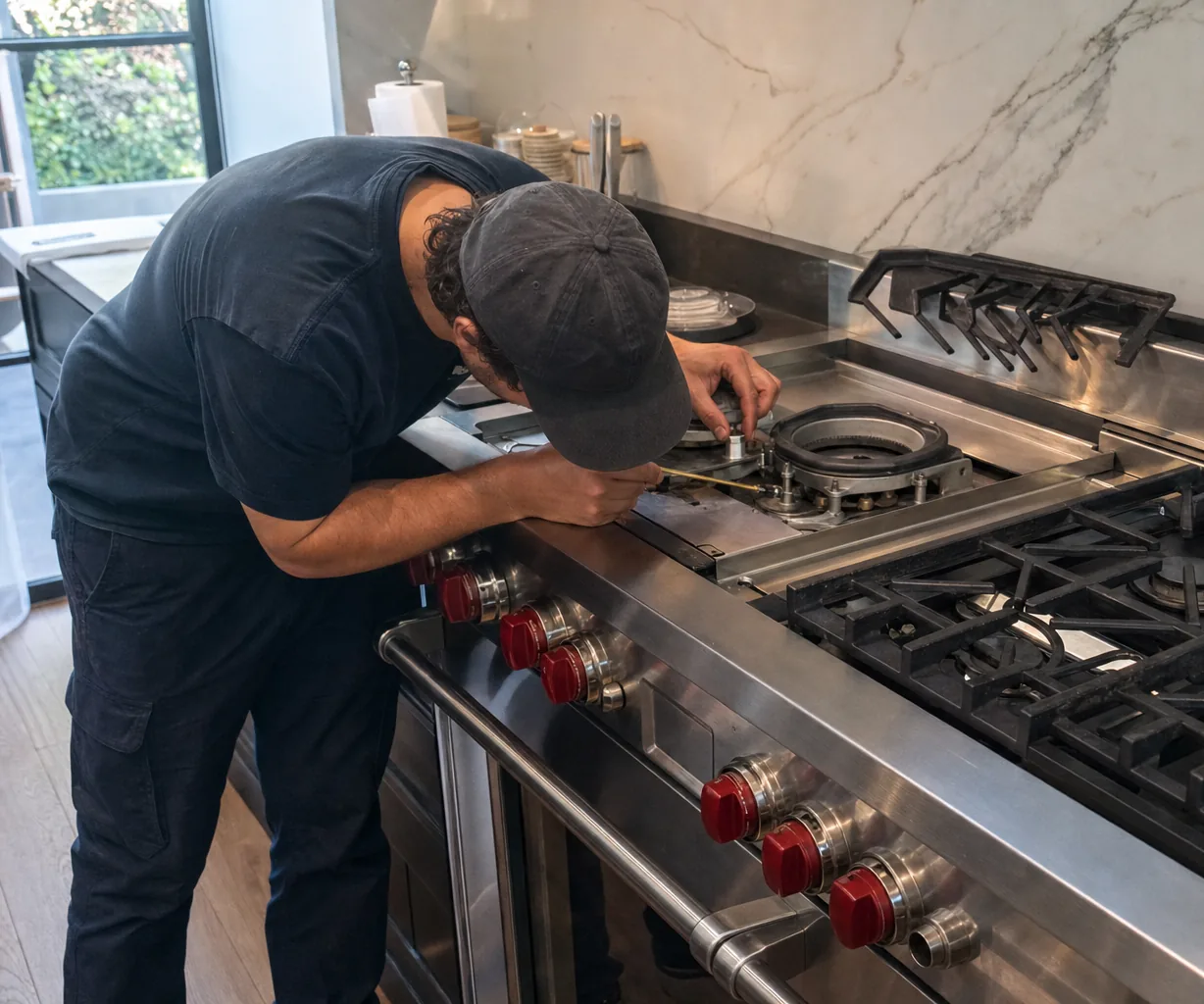
Burner and ignition faults are the largest single share of what this van gets called out for, and most of them are cheaper than the homeowner expects. A sealed burner that sparks and will not light has a short list of causes, and three of the four common ones involve no part at all.
That is not a marketing line. It is what the van gets called out for.
The other reason this class of fault dominates is age. A great many Clay County kitchens went in together and their original electrodes have now been sparking through a decade of humid air, which opens the gap and crazes the ceramic. The same subdivision produces the same complaint within a year or two of itself.
A spark module that clicks and clicks without producing flame is reporting one of four things, and only one of them needs a part.
The first is a wet or fouled electrode. Boil-over runs down the burner base, dries into a conductive film, and the spark tracks across the residue to the nearest metal instead of jumping the gap to the burner cap. The click is healthy. The spark is simply going somewhere useless.
The second is a burner cap seated a fraction of a turn off its ring. Sealed burners are unforgiving about this. Lift the cap, look at the slot pattern, seat it flat, and a burner that would not light for a week lights on the first click.
The third is a cracked ceramic insulator at the electrode. Once the ceramic is split, the spark finds ground through the crack. You can often hear the difference — a sharp snap instead of a clean tick.
The fourth is the spark module itself, and it is the least common of the four. A module that fires every position at once when a single knob is turned is usually reporting a shorted switch rather than a dead module.
Blue flame with a small inner cone means the air and gas ratio is right. Yellow, lazy, or lifting flame means it is not, and the cause is nearly always mechanical rather than electrical.
Checked in order: the orifice for the fuel the appliance is actually connected to, the air shutter setting, debris in the venturi, and burner port blockage. Plenty of kitchens on this side of the river run on propane rather than piped natural gas, and the orifice set has to match. A range built for one fuel and connected to the other burns wrong from the first day and never improves on its own, no matter how many times the burner is cleaned.
A dual-stacked burner keeps a separate low-output flame ring alive under the main one, which is why the low end can fail while the high end works perfectly. If the burner runs hard but drops out below the mid position, the fault is usually in the low port set or the valve’s simmer stop, not in the ignition system that gets blamed for it.
Flame that dies the moment the knob is released is a different circuit entirely. That is flame sensing telling the gas valve it never saw a flame. Position, oxidation and continuity get checked before the valve is condemned, because a good valve is an expensive thing to replace by guess.
The appliance gets tested on the fuel it is actually running, not on a generalisation. Electrode gap and seating first, then the flame picture, then the switch and module circuit, then supply pressure if the whole top is soft. Parts come last.
You get a written estimate before anything is ordered. Genuine OEM parts only — no aftermarket substitutes on sealed gas, ignition or control components. Ninety days on labor, 365 days on the parts themselves.
The bands a fault like this lands in run $210 to $680, parts and labor together, depending on which component turns out to be at fault.
$80 Flat $80 diagnostic covering the visit and the full diagnostic sequence, credited toward the repair once you approve the work.
| Repair | Parts and labor |
|---|---|
| Igniter or spark module replacement | $210–$530 |
| Burner valve or orifice service | $220–$680 |
| Diagnostic visit | $80 |
Bands, not quotes. 90 days on labor, 365 days on parts. Genuine OEM parts only.
4.9
out of 5 across 82 customer reviews of this shop. Each one below is a single call, in the words of the person who paid for it.
The left front burner clicked on and on without catching. He lifted the cap, showed me it had been seated a half turn off after a cleaning, dried the spark electrode and reset it. First click every time now.
Marisol H.2026-07-28
Our rangetop had a burner that would light and then drop out as soon as the knob came back. He explained that the flame sensor has to sit in the cone, corrected its position, and it has held on low ever since.
Oriana C.2026-08-27
The griddle module ran hotter at one end than the other. He levelled the plate, cleaned the burner beneath it, and confirmed the spread with a surface thermometer at several points. Even heat right across now.
Isadora F.2026-06-18