Two zones on the induction top stopped recognising pans. He located a failed sensing coil under the glass, showed me the scorch mark on it, and fitted the replacement without pulling the counter apart.
Yolanda F.2026-08-09
One zone dead, all zones dropping out, pans not detected, or a cooling fan that never stops. Glass-top cooking with no gas line involved.
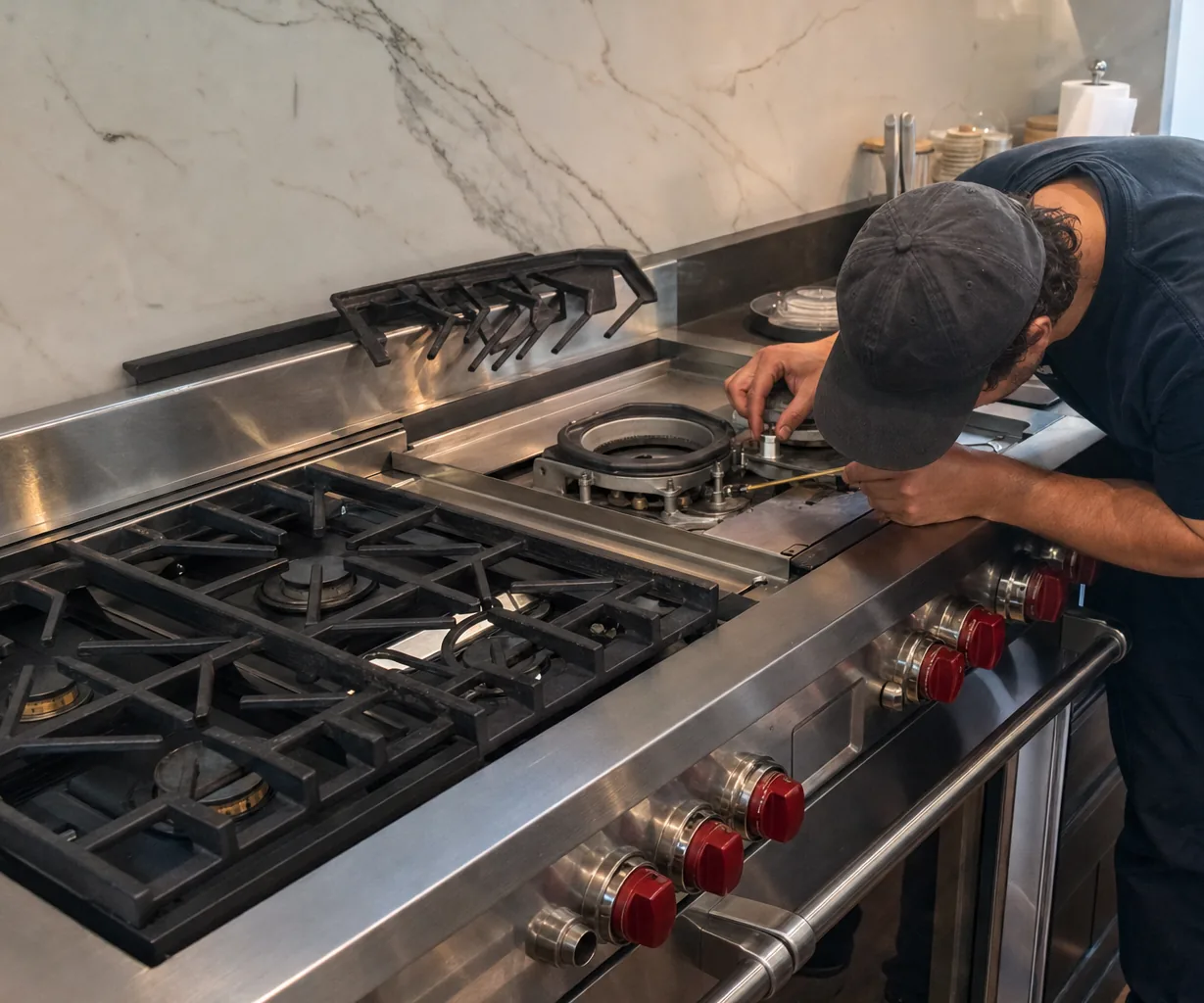
Induction is the quietest appliance in a Clay County kitchen until it is not. There is no flame to look at and no burner to reseat, so the diagnosis is electrical from the start — but it is still mostly a heat-management problem, which is the part people miss.
Counterintuitive, but true. Each zone has its own coil and its own power stage. When exactly one zone stops working and the rest of the cooktop behaves perfectly, the shared supply and the shared user interface have both just proved themselves. The fault is in that zone’s coil, its power module, or the ribbon between the module and the control.
When every zone dies at once, the suspects invert: the supply, the interface, or the thermal protection that shuts the whole unit down.
A cooktop that refuses a pan is usually right. Induction needs a ferrous base with enough contact area, and a warped base lifts the centre away from the glass. Cookware that worked for years can stop working after it has been dropped or run dry once too often.
Detection that fails across every pan on every zone is a different matter and points at the sensing circuit or the control.
An induction cooktop cools itself. Underneath the glass there is a fan pulling air through the electronics, and it needs a clear intake and a clear exhaust path in the cabinetry.
Two local habits break this. The first is a drawer stack or a base cabinet retrofitted under a cooktop with no clearance left for airflow. The second is an installation over a wall oven where the oven’s own exhaust rises straight into the cooktop’s intake. In both cases the symptom is identical and misleading: everything works for five or ten minutes at high power, then zones drop out one at a time and come back once the unit cools. That is thermal protection doing its job, not a failing coil.
A fan that runs constantly, long after cooking, is often reporting the same condition from the other direction.
Sixty-eight thunderstorm days a year in this county land squarely on cooktop electronics, and an induction unit has more of them to lose than a radiant one: an interface board, a power stage per zone and the cooling fan that keeps both alive. The failures are rarely immediate. After the long outages of 2016, 2017 and 2024 the pattern was the same each time — zones dropping out or a dead interface weeks later, in units that had worked since the power came back.
Cracked glass is not repairable and is not safe to keep using. A crack lets liquid reach the coils and the electronics beneath, and on a bridged or full-surface zone it changes how the field is contained. The honest answer, delivered on the first visit, is what a replacement surface costs against the value of the appliance — some are worth it and some are plainly not.
Supply and both legs at the appliance, then interface response, then per-zone coil and module testing, then clearance and airflow in the cabinet. That last step is skipped by most people and is the reason a replaced module fails again the same summer.
Written estimate before parts. Genuine OEM parts, 90 days on labor, 365 days on parts.
The bands a fault like this lands in run $270 to $1,100, parts and labor together, depending on which component turns out to be at fault.
$80 Flat $80 diagnostic covering the visit and the full diagnostic sequence, credited toward the repair once you approve the work.
| Repair | Parts and labor |
|---|---|
| Control board or touch panel | $470–$1,100 |
| Convection fan or motor | $270–$710 |
| Diagnostic visit | $80 |
Bands, not quotes. 90 days on labor, 365 days on parts. Genuine OEM parts only.
4.9
out of 5 across 82 customer reviews of this shop. Each one below is a single call, in the words of the person who paid for it.
Two zones on the induction top stopped recognising pans. He located a failed sensing coil under the glass, showed me the scorch mark on it, and fitted the replacement without pulling the counter apart.
Yolanda F.2026-08-09
The touch panel responded when it felt like it. He lifted the glass, found a ribbon connector backing out of its seat from heat cycling, reseated and secured it, and the controls have been steady since.
Philippa J.2026-04-09
Power kept cutting to half the surface at random. He traced it back to a scorched terminal block in the junction box rather than the appliance, and rebuilt that connection with proper lugs. Nothing has tripped.
Emeline G.2026-04-09