Questions, answered plainly
Every question here gets asked on real calls. Where the honest answer is 'that is not your problem', it says so.
- Entries
- 18
- Diagnostic
- $80
- Brand
- Wolf
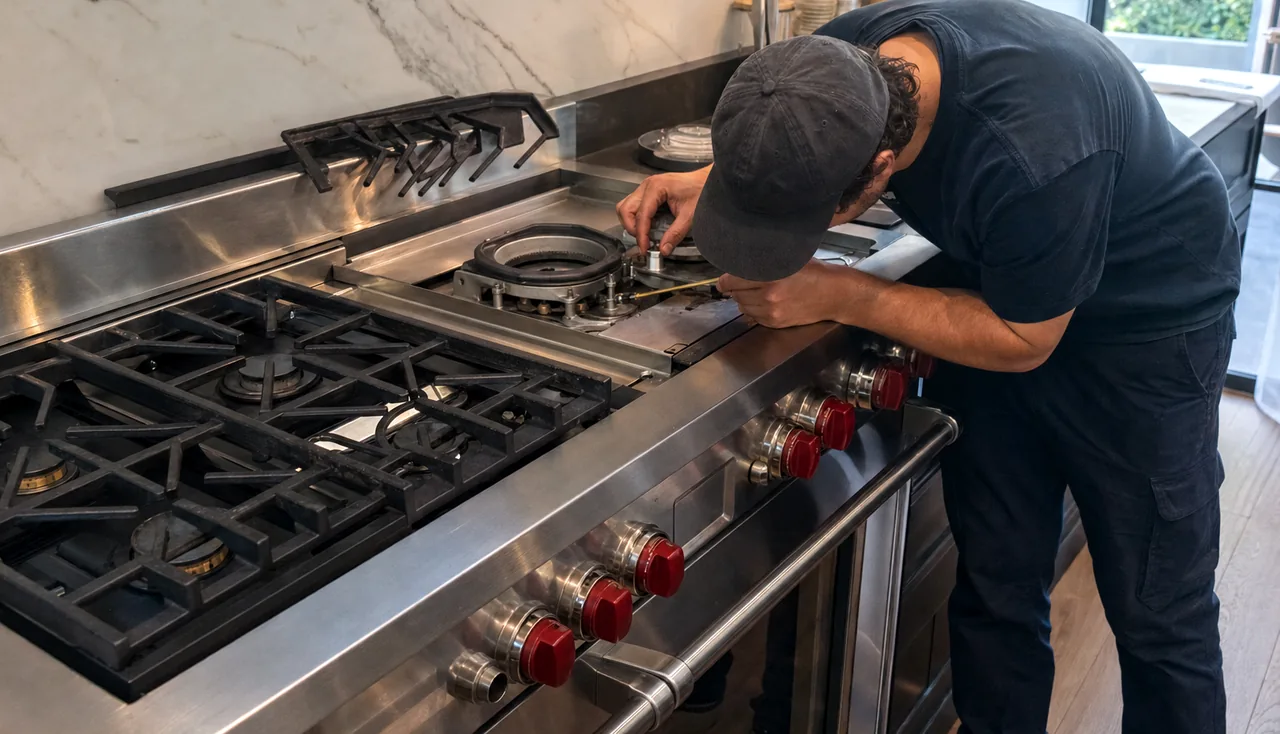
The shop
- Are you a Wolf factory service center?
- No. Nobody at the factory sent us, appointed us or vets us, and we hold no manufacturer programme of any kind. We repair Wolf cooking equipment and we use the brand name only to identify the appliances we work on. If your unit is still inside the manufacturer's warranty period, call Wolf first — a factory-covered repair should cost you nothing. The formal statement of our standing is in the footer of every page.
- Do you work on other appliance brands?
- No. Wolf cooking equipment only — ranges, rangetops, cooktops, wall ovens, convection steam ovens, speed ovens, warming drawers, outdoor grills and ventilation. Staying with one manufacturer is why the right part is usually already on the van.
- Do you work on heating or air conditioning?
- No. This is a built-in kitchen shop: Wolf cooking equipment and the ventilation over it. Furnaces, heat pumps, air handlers, condensers, thermostats and the house duct system are an HVAC trade, and a call about one gets told so on the phone rather than booked. The only duct here runs from a kitchen hood to its cap.
The appliance
- My steam oven says it needs water and the tank is full. What is that?
- Usually the pickup line behind the reservoir, kinked or unseated when the tank went back in, so the level being sensed is not the level you can see. The other common causes are a pump that lost prime, a thermal fuse that opened and cannot reset, or on a plumbed unit a filter cartridge left in past its life. The control board is checked last, because it is the most expensive assumption on the list and the least often correct.
- Which cooking appliances does this shop actually work on?
- Ranges and rangetops, cooktops in gas, induction and electric, built-in wall ovens, convection steam ovens, speed ovens, warming drawers, built-in outdoor gas grills and the ventilation over all of it. Cooking and ventilation is the whole scope, deliberately, because it is what the operator works on every week.
- Why is the control board always the last thing you check?
- Because it is the most expensive assumption available and the least often correct. Supply under load, one-shot devices, sensors and then the mechanical side account for the large majority of calls, and every one of those is cheaper. A board condemned before the supply has been measured tends to get replaced twice.
Money
- What does the first visit cost?
- A flat $80 diagnostic. It covers the trip, the testing and a written estimate, and it is credited toward the repair when you approve the work. One fee per visit, not one per fault, so a range with a dead igniter and a drifting oven thermostat is still a single charge.
- Do you charge by the hour or by the job?
- By the job. There is a flat $80 diagnostic for the visit and the full test sequence, and after that the repair is quoted as a finished figure covering the part and the labor to fit it. No hourly meter runs while a panel is off, and nothing is billed for the time a diagnosis takes to think about.
- What makes one quote higher than another on the same appliance?
- Which component is actually at fault, first and mostly. After that: whether the part rides on the van or has to be ordered, whether there is one fault or two behind the same complaint, and whether something upstream caused it. The published band table shows the spread those four things move within.
- How do you decide whether an appliance is worth repairing?
- By setting the repair band against what the same equipment costs new, which is done on one page here rather than argued on the phone. On built-in cooking equipment the repair almost always wins; what changes the answer is a discontinued part or an opening no current model fits, not the age of the unit.
- What is covered after the repair?
- 90 days on labor and 365 days on parts. Genuine OEM parts only — no aftermarket substitutes on sealed gas, ignition or control components. If the same fault returns inside the labor window, the return visit is not billed.
Getting a visit
- Which areas do you cover?
- Orange Park and Clay County first, including Oakleaf Plantation, Eagle Harbor, Pace Island, Fleming Island and the Doctors Lake frontage, then roughly 40 miles out from there. Scheduled appointments Monday to Friday 8am to 6pm and Saturday 9am to 4pm. No after-hours or emergency service.
- What should I have ready before the technician arrives?
- The model and serial designation from the rating plate, which is usually behind a door or under a drawer, and a clear account of what the appliance was doing when it stopped. Mid-cycle, at ignition or on power-up narrows the list faster than anything measured later.
- What happens if the part has to be ordered?
- The estimate is written down before anything is ordered, and the return fitting visit is not a second diagnostic. Staying with one manufacturer means the common ignition, sensor and thermal parts are usually already on the van, so an order is the exception rather than the routine.
Afterwards
- Is your warranty the same as the manufacturer's warranty?
- No, and the two do not interact. This warranty covers the workmanship and the parts supplied on the invoice. If the appliance is still inside the manufacturer's own coverage period, call the manufacturer first, because that route should cost you nothing.
- How is a warranty claim made?
- By telephone, with the invoice date and the model and serial designation from the rating plate. There is no form and no claim portal here. The same technician who did the work takes the call, which is the shortest route to sorting it out.
The writing
- Why publish bench notes rather than repair tips?
- Because most of what fails locally is decided by how houses here were built, not by the appliance alone. A note that explains a truss attic duct run or a storm-season supply sag tells you whether to call at all, which is more use than a list of steps.
- Should I attempt any of this myself?
- The checks that need no tools and no live circuit, yes: how a burner cap is seated, whether a reservoir went back in square, whether a vent is blocked. Anything involving gas pressure, a live supply or a removed panel is where a visit is worth more than the guessing.
What helps before the visit
Four answers shorten almost every call. The first is the model and serial number, which are on a data plate — behind the kick panel or inside the door frame on most built-ins, under the control panel on a rangetop. Components change mid-production, so the serial is what decides which version of a part fits, and having it before the appointment is the difference between a part that travels on the van and a part that gets ordered.
The second is what the appliance was doing when it stopped: mid-cycle, at ignition, on power-up, or after the house lost power. The third is whether anything was changed recently — a tank pulled for cleaning, a filter replaced, an appliance moved from another house, a remodel that altered the ducting or the gas supply. The fourth applies to built-ins only: if a replacement is on the table, the opening gets measured for width, height, depth and the position of the electrical and gas stubs inside it, because a unit that does not fit its cutout is a carpentry job rather than a repair.
Appointments are scheduled: Monday – Friday 8:00am – 6:00pm · Saturday 9:00am – 4:00pm · Sunday Closed. Scheduled appointments only. No after-hours or emergency service.
Where to go next
- Burner and ignition: clicks, sparks, no flame
- Wall ovens and controls: not heating, drift, dark panels
- Steam ovens: no steam, standing water, a dead panel
- Induction and electric cooktops: dead zones, pan detection
- Hoods and blowers: weak capture, noise, dead speeds
- Outdoor gas grills: no light, cold section, seized valves
- Pricing
- Warranty terms
- Coverage by county
- Bench notes