Our blower had slowed to almost nothing on the lake side of the house. He found the motor windings failing under load, showed me the current draw against the plate, and fitted a matching motor the week after.
Anders K.2026-04-15
Hoods that run but do not capture, blowers that howl, speeds that have gone dead, and downdrafts that will not rise. Ducting gets checked, not just the motor.
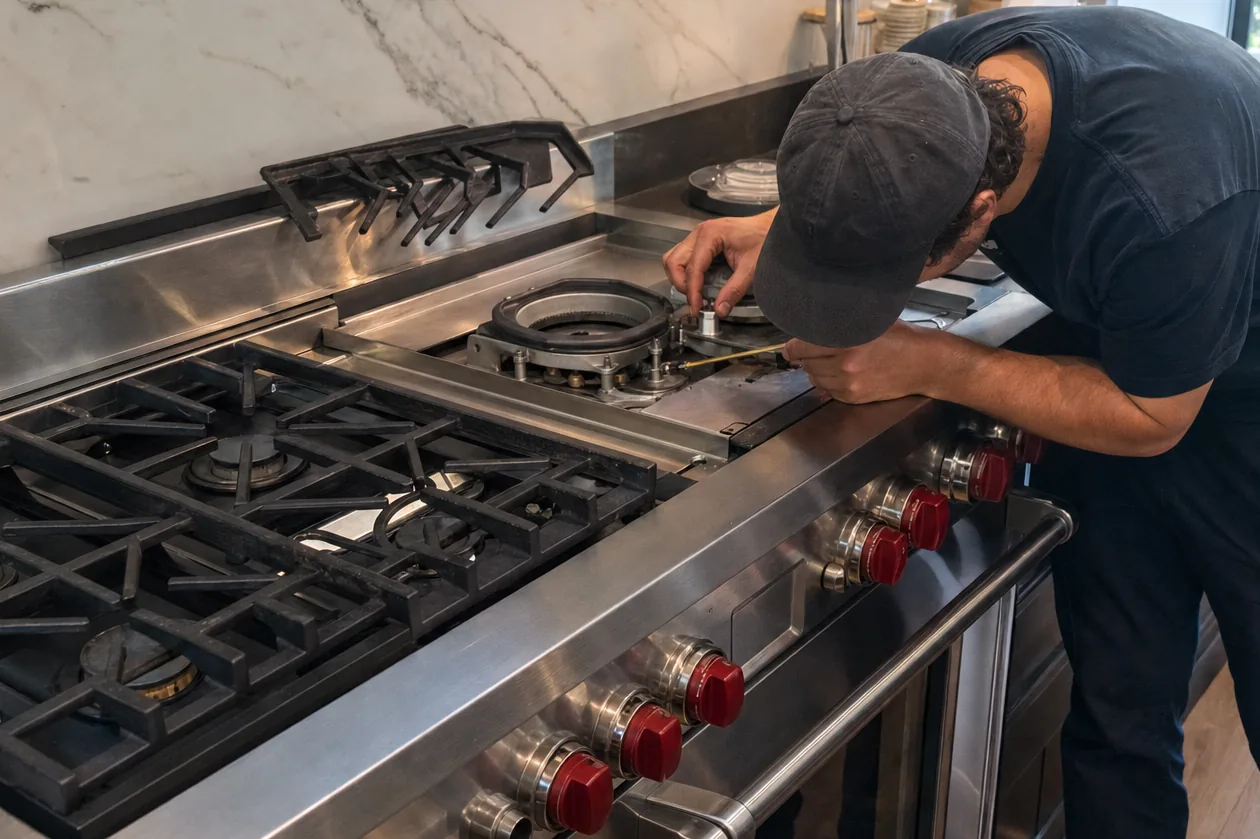
Most hood complaints are not blower failures. The blower is turning, the lights work, and the kitchen still fills with smoke every time a rangetop is used properly. That is a duct problem wearing a motor problem’s clothes.
A hood only captures what sits inside its plume. Before anything electrical is tested, three measurements get taken: the width of the hood against the width of the cooking surface, the mounting height above it, and the depth of the canopy against the depth of the burner grate.
Undersized and over-high are the two failures, and both are installation decisions rather than appliance defects. A hood mounted flush with an upper cabinet run to keep sight lines clean will lose the front burners no matter how much air it moves.
The newer subdivisions on this side of the river — Oakleaf Plantation and the Argyle Forest corridor among them — are built slab-on-grade under truss attics, with no basement and no chase to work in. That geometry pushes hood ducting horizontally across the attic to a roof or gable termination, sometimes a long way, and every elbow in that run costs airflow equivalent to several feet of straight pipe.
Three things go wrong up there, and all three are invisible from the kitchen:
Older houses closer to the river often have the opposite problem: a short run straight out through an exterior wall, but a wall cavity too shallow to take a proper transition without crushing it.
A powerful blower in a tightly built house has to pull its replacement air from somewhere. When it cannot, it pulls backwards through whatever path is easiest, and the hood’s own measured airflow falls well below its rating. Symptoms include doors that resist opening while the hood runs, and back-draft when the air handler cycles at the same time.
This gets identified honestly on the diagnostic, even though the fix is sometimes outside the appliance.
Outside the appliance also means outside this shop. Where the honest answer is make-up air, a house sealed tighter than its kitchen, or an air handler and the hood fighting each other for the same cubic feet, that is an HVAC contractor’s work. Heating, cooling and the duct system serving the rest of the house are not serviced here and never have been, and nobody gets sold a blower to cure them. This van stops at the hood, its own duct to the roof or wall cap, and whatever Wolf built into it.
Genuine hood faults are usually one of four: a failed speed on a multi-tap motor or its control, a blower wheel out of balance from accumulated grease, a seized bearing that announces itself as a rumble weeks before it stops, or a downdraft’s lift mechanism — a belt, a gear rack or a limit switch — rather than the fan at all.
Baffle filters that are washed in a dishwasher and reinstalled slightly deformed cause a surprising amount of noise. That one costs nothing to fix.
Owners describe hood noise as loud or quiet. What matters is what kind.
A rush of air that rises smoothly with speed is the sound of a hood working. A rumble that appears at one speed and disappears at another is nearly always an out-of-balance blower wheel. A whine that tracks with speed points at a bearing. A rattle at high speed alone is usually a filter that no longer sits square in its track, often after being washed in a dishwasher and coming out slightly deformed.
Sound that changed suddenly deserves attention sooner than sound that has been there for years. A bearing announces itself weeks before it seizes, and replacing it before it takes the motor with it is a materially cheaper job.
Sizing and mounting first, then filters and the blower wheel, then the motor and speed control, then the duct path as far as it can be inspected. You get a written estimate before any part is ordered, genuine OEM parts, 90 days on labor and 365 days on parts.
The bands a fault like this lands in run $270 to $710, parts and labor together, depending on which component turns out to be at fault.
$80 Flat $80 diagnostic covering the visit and the full diagnostic sequence, credited toward the repair once you approve the work.
| Repair | Parts and labor |
|---|---|
| Convection fan or motor | $270–$710 |
| Diagnostic visit | $80 |
Bands, not quotes. 90 days on labor, 365 days on parts. Genuine OEM parts only.
4.9
out of 5 across 82 customer reviews of this shop. Each one below is a single call, in the words of the person who paid for it.
Our blower had slowed to almost nothing on the lake side of the house. He found the motor windings failing under load, showed me the current draw against the plate, and fitted a matching motor the week after.
Anders K.2026-04-15
The downdraft rose halfway and stopped there. He found the lift belt slipping on a worn pulley rather than a failed motor, changed the belt and the pulley together, and it runs its full travel again without hesitating.
Odette V.2026-05-01
Smoke was rolling back into the kitchen instead of going up. He checked the roof damper and found it stuck half shut with lint and paint overspray from a repaint. Freed and lubricated, and the draw is right.
Tamsin B.2026-07-11