The panel went dark during a week of storms. He tested the supply first, then the board, and the board had gone. The part was slow to arrive, which was frustrating, but the work itself was tidy.
Hollis W.2026-03-05
No steam, weak steam, water left standing in the cavity, or a unit that stops mid-cycle. Most of these faults are in the water path, not in the board.
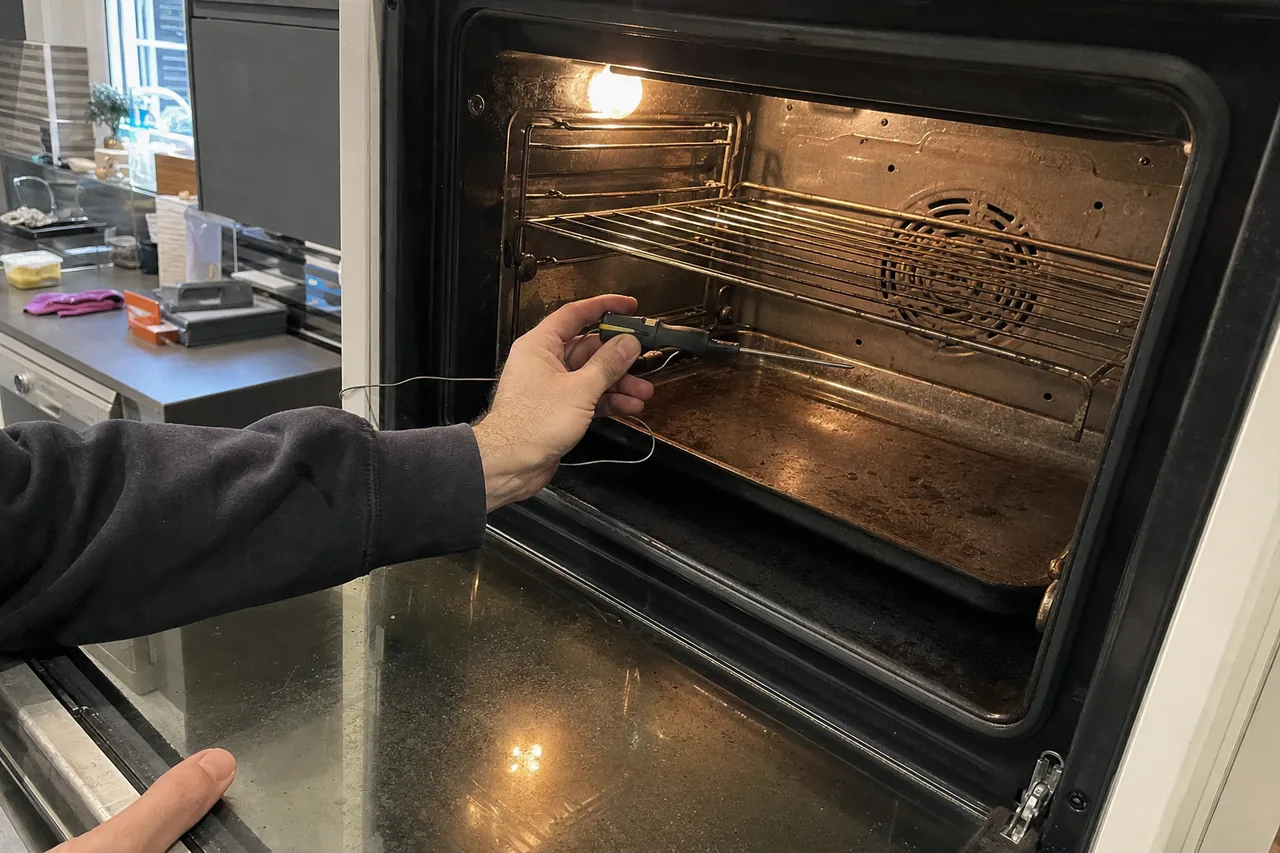
A steam oven has more ways to stop than a conventional one, because it has a water path as well as a heat path and a control that will refuse to run if either looks wrong to it. Most of what brings this appliance out of service sits in the water path, and most of that is reachable without touching the electronics at all.
The first question is which kind you have, because it changes the fault tree before anything is opened.
A tank-fed unit draws from a removable reservoir through a pickup line and a pump. The reservoir is the one part of the appliance an owner handles routinely, which makes it the most disturbed part of the machine and the most common origin of a no-steam complaint.
A plumbed unit takes a supply line, usually through an inlet valve and a filter cartridge. It removes the reservoir failures and adds its own: a valve that does not open, a shut-off that was closed and forgotten during other work, and a filter left in service past its life. A restricted filter cuts flow long before it stops passing water, and restricted flow reads exactly like a weak pump.
The reservoir line. The tank gets pulled for cleaning more often than any other part of this appliance, and the pickup line behind it gets kinked, unseated or pinched on the way back in. The unit then reports low water with a full tank, because the level it is measuring is not the level you can see.
The pump. A pump that has run dry a few times — easy to do if the tank is routinely emptied but the cycle is not — loses prime and sometimes loses the impeller. It will still hum. Hearing it run proves nothing.
A thermal fuse. These are one-time devices. They open on an overheat event and never reset. When one opens, the unit will often power up and behave normally right until the moment heat is demanded, which sends people looking at the control board.
The control board. This county gets roughly sixty-eight thunderstorm days a year. Brief outages and the sag when power returns are hard on the low-voltage supply inside a steam oven, which sits in a cabinet with poor airflow to begin with. The damage is often delayed — after the long outages of 2016, 2017 and 2024 the failures landed weeks later — so a unit that has been fine since the storm is not thereby cleared.
JEA publishes tap-water hardness by ZIP code, and Orange Park’s 32073 is listed at 128 ppm. That is real mineral content, and two places concentrate it: the evaporator surface, where water is driven off and whatever it carried stays behind, and the small orifices and the level probe, where even a thin deposit changes a reading. Descaling belongs on the maintenance calendar for that reason — it is simply the wrong first guess once an appliance has already stopped working.
Water on the cavity floor after a cycle is a drain path problem, not a steam generation problem. The drain, the trap and the cavity slope get checked, along with the door seal, because a door that is not sealing lets condensate form where it should not and drop where it cannot leave.
A door that has dropped slightly on its hinges produces the same symptom without any part having failed, so hinge and latch alignment get checked before a gasket is quoted.
The first is what the unit was doing when it stopped. A steam oven that quit mid-cycle points somewhere different from one that never started, and a unit that failed in the week after an outage points somewhere different again.
The second is when the tank was last removed. That single answer resolves a surprising share of no-steam complaints, because the reservoir and its pickup line are the parts most easily disturbed on reassembly.
These units are built in, usually at eye level and often in a tall stack with a second oven. Working the water path means bringing the unit forward, which needs the run in front of it clear and, on a heavy install, a second pair of hands. Where the surround was retiled or a counter overlaid after installation, the unit may not clear its opening at all, and that is established before the appointment rather than halfway through it.
Parts are ordered against the model and serial from the data plate. Pumps, valves, fuses and probes were revised through production, so the serial decides which version fits, and a superseded part legitimately carries a different number than the manual shows.
Tank, line and level circuit first. Pump next, on a live test rather than by ear. Fuse and heater continuity after that. The board last, because it is the most expensive assumption on the list and the least often correct.
Written estimate before parts, genuine OEM components, 90 days labor and 365 days parts.
The bands a fault like this lands in run $180 to $1,100, parts and labor together, depending on which component turns out to be at fault.
$80 Flat $80 diagnostic covering the visit and the full diagnostic sequence, credited toward the repair once you approve the work.
| Repair | Parts and labor |
|---|---|
| Convection fan or motor | $270–$710 |
| Control board or touch panel | $470–$1,100 |
| Oven thermostat or temperature sensor | $180–$550 |
| Diagnostic visit | $80 |
Bands, not quotes. 90 days on labor, 365 days on parts. Genuine OEM parts only.
4.9
out of 5 across 82 customer reviews of this shop. Each one below is a single call, in the words of the person who paid for it.
The panel went dark during a week of storms. He tested the supply first, then the board, and the board had gone. The part was slow to arrive, which was frustrating, but the work itself was tidy.
Hollis W.2026-03-05
The convection fan in the steam unit had picked up a whine. He took the rear panel off, found the bearing dry and the blade running out of true, fitted a new motor and rechecked the noise at each speed.
Owen D.2026-05-21
After an outage the steam oven simply would not wake up. He measured the supply first, found a thermal cutout had opened on recovery, and replaced that rather than the control everyone else had pointed at.
Graham K.2026-03-19